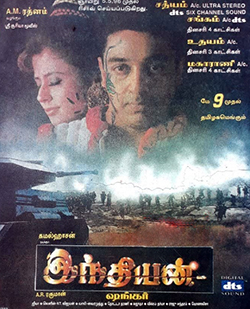
Kamal Haasan’s Indian (1996) is a Tamil vigilante action classic that battles corruption with power and purpose. Read our in-depth review of Shankar’s iconic film.
⭐ BMR Rating: 9/10
Genre: Vigilante Action Drama | Language: Tamil | Runtime: 185 minutes | Director: S. Shankar
📝 Synopsis
Indian (1996), directed by visionary filmmaker S. Shankar, is a landmark Tamil film that blends social commentary with powerful storytelling and spectacular filmmaking. The story follows Senapathy (played by Kamal Haasan), a freedom fighter from the pre-independence era who becomes a vigilante in modern India, eliminating corrupt officials. His mission brings him into direct conflict with his own son Chandru (also Kamal Haasan), a small-time government employee entangled in bribery and unethical shortcuts.
What unfolds is a gripping father-son confrontation set against the broader landscape of systemic corruption, moral decay, and the lost ideals of India’s freedom struggle.
🎭 Performances
Kamal Haasan delivers a career-defining dual performance. As Senapathy, he transforms into an aged freedom fighter with conviction, body language, and voice modulation that feel remarkably authentic. His portrayal brings dignity and righteousness to the character, reminiscent of real-life revolutionaries.
As Chandru, he is the polar opposite — casual, opportunistic, and charming — representing the modern generation’s apathy. The seamless switch between these two drastically different roles shows Haasan’s unmatched range and acting prowess.
Manisha Koirala and Urmila Matondkar add emotional and romantic layers to the story. Manisha’s character adds grace, while Urmila, through her bubbly charm, represents youthful innocence. Though their roles are not central to the plot, they balance the intense narrative with lighter moments.
Veteran actors like Nedumudi Venu, Manorama, Senthil, Goundamani, and Nizhalgal Ravi provide strong support and, in some cases, comic relief. The combination of drama, humor, and strong character arcs makes the ensemble cast effective.
🎬 Direction & Screenplay
S. Shankar, known for his flair for socially relevant themes wrapped in commercial formats, delivers one of his most impactful stories with Indian. The screenplay is tight and layered, alternating between flashbacks to pre-independence India and the present-day corrupt system. The use of dual timelines allows the film to showcase how India’s ideals were compromised over time.
The dialogues, penned by Sujatha, are powerful and poetic, especially those delivered by Senapathy as he condemns the rot in modern Indian bureaucracy. The film doesn’t shy away from harsh truths, and Shankar’s direction makes sure every message lands with cinematic impact.
🎥 Cinematography & Editing
Jeeva’s cinematography is dynamic and ambitious, especially for its time. The visuals range from rural villages and government offices to big-budget song sequences. The transition from nostalgic sepia tones to urban realism is beautifully handled.
The editing by B. Lenin and V. T. Vijayan keeps the nearly three-hour film engaging. Despite its length, the story moves at a steady pace, alternating between action, drama, and emotional tension without losing momentum.
🎶 Music & Background Score
The soundtrack, composed by A. R. Rahman, remains iconic even today. Songs like:
- 🎶 “Maya Machindra” – catchy and energetic
- 🎶 “Akkadanu Naanga” – visually rich and musically complex
- 🎶 “Kappaleri Poyachu” – a folk masterpiece
…blend into the narrative rather than interrupt it. Rahman’s background score is as impactful as the songs, heightening emotional beats and tension throughout.
✅ Strengths
- 🎭 Stunning dual performance by Kamal Haasan
- 🎬 Visionary direction by Shankar with strong social messaging
- 🎵 Iconic music by A. R. Rahman
- 📽️ Cinematic visuals that still hold up
- 🕊️ Patriotic undertone with emotional depth
- ✍️ Thought-provoking dialogues by Sujatha
❌ Weaknesses
- ⏳ Slightly long runtime (185 mins) may test modern viewers
- 💃 Romantic subplots feel secondary and sometimes distract from the core
- 📉 Some scenes are melodramatic by today’s standards
🎯 Final Verdict
Indian (1996) is not just a film; it’s a movement. It holds a mirror to society and questions how far we’ve drifted from our ideals. Kamal Haasan’s dual performance is legendary, and S. Shankar’s fearless direction turns this film into one of Indian cinema’s most compelling explorations of justice, morality, and patriotism.
Even nearly three decades later, the film remains relevant, powerful, and emotionally moving. With Indian 2 on the horizon, it’s the perfect time to revisit this masterpiece that redefined the vigilante genre in Tamil cinema.
🍿 Watch It If You Like:
- Patriotic action dramas like Rang De Basanti
- Vigilante justice stories with a message
- Kamal Haasan’s transformative performances
- Shankar’s socially conscious blockbusters
BMR Rating: ⭐ 9/10
A powerful blend of mass entertainment and meaningful messaging, Indian (1996) is a true Tamil cinema classic.